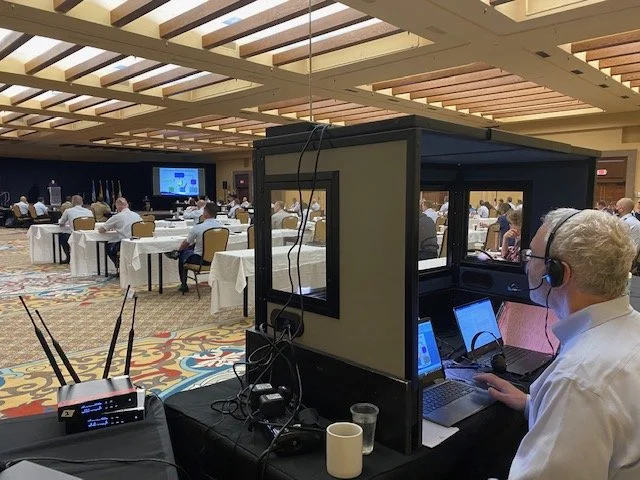
There are unexpected perks in conference work. Recently, we got to have playtime with puppies during a lunch hour.

We appreciate proactive planning
As interpreters, we love clients who lay the ground rules for successful communication.
Thank you, Brent Koren!
As interpreters, we love clients who lay the ground rules for successful communication.
Interpreters and Language Variation in Conference Work
We at Sonora Translators provide our services to entities from industry, media, academia, commerce, and government, who have relied on us to communicate effectively with Spanish speakers. We make it possible for our clients to understand and be understood by folks who come from far and wide in the Spanish-speaking world.
Recently, someone asked us how interpreters are able to understand presenters who hail from far away. That is a legitimate question – geographical location powerfully determines spoken language. Wording and syntax do not walk in lockstep across countries with the same language. Ask a Spaniard or a Latin American, and you will be rewarded with colorful examples that contrast their own form of Spanish against what is heard from the mouths of people from any other of the 20 Spanish-speaking countries.
The same thing happens with English. For sure, even within the United States, variations in wording, phrasing and accent quickly reveal their provenance within our country; domestic diversity aside, we’re regarded as a unified country that speaks what is called American English. Also, Englishes other than our domestic U.S. brand are commonly spoken at international conferences.
So, what impact do these variations in language have on conference work? The short answer is that conference presenters, independently of the language they’re using, overwhelmingly perform in a standard version of it endowed with broad-spectrum intelligibility. ‘Standard’ refers to what may be heard, for instance, in public broadcasting, a variety that eschews hyperlocal idioms and tends to be reasonably serviceable in the trade of international communication. (On the odd occasion, an obscure metaphor may make an appearance, but we’ll talk about that another day.) For sure, both Spanish- and English-speaking presenters often delight us with expressions that we’re able to comprehend, while we’d convey them differently ourselves.
In fact, it is largely the vernacular spoken word that runs wild with idiosyncratic variations -- colloquialisms, humor, slang and idioms that originate from social or regional groups with specific dialectal characteristics of their own that deviate from the standard linguistic currency of their larger geographical and cultural area. The vernacular is decidedly not what is heard in multi-national meetings.
Also, we interpreters are accustomed to receiving written materials to help us prepare in advance of an event. We’ve also been hired to attend the formal meetings’ rehearsal, which gives us an invaluable opportunity to become acquainted with what is going to be said during the conference. Preparation makes our work not only possible, but quite enjoyable.
Long live standard language and preparation.
Interpreters need optimal sound
This article explains why we as interpreters need the best sound quality we can get. After all, our job consists largely of simultaneously listening and talking, a situation where our own voice naturally interferes with what is being input into our mind through our ears for proccessing.
https://interpretersoapbox.com/why-interpreters-need-better-sound-than-normal-listeners-bad-sound-in-videoconferencing-explained/?fbclid=IwAR0UlzBFc5gpblYALhhMGjQguXZ3ke4oUqD2ZnEGtvPFJgQWPobujwW1b9I&fs=e&s=cl#comments
Thanksgiving
Before the holiday frenzies strike in full next month, Thanksgiving serves as the perfect occasion to express our appreciation for the work we’ve enjoyed this year.
We’re tickled to have been chosen to provide our services in meaningful projects where we ourselves gained new insights and knowledge. Top in our minds are the conferences with the University of Arizona National Center for Interpretation with Mexican legal scholars in the Diplomado program; with the Arizona Commission on the Arts Rural BIPOC movement-as-art program for the elderly; and the Arizona-Sonora Megaregion meetings that foster cooperation among all three North American countries.
In July, the National Association of Community Health Workers online conference showcased and honored the dedicated women and men who promote health and wellbeing in their communities throughout the United States.
On a different note, the sheer excitement of multiple-day sales meetings at plush Arizona resorts carried us for hours. The keynote speakers’ contagious energy infused us with generous doses of adrenaline.
For sure it’s hard to pick a single event as our favorite, but particularly enjoyable have been the high-level U.S. Air Force Leadership Conferences with Central and South American top brass, where we proudly assisted in the strengthening and renewal of cooperation between our Western Hemisphere partner nations.
In short, we’re ever thankful for the plentiful work 2021 brought us, along with a return to a sense of normalcy.